
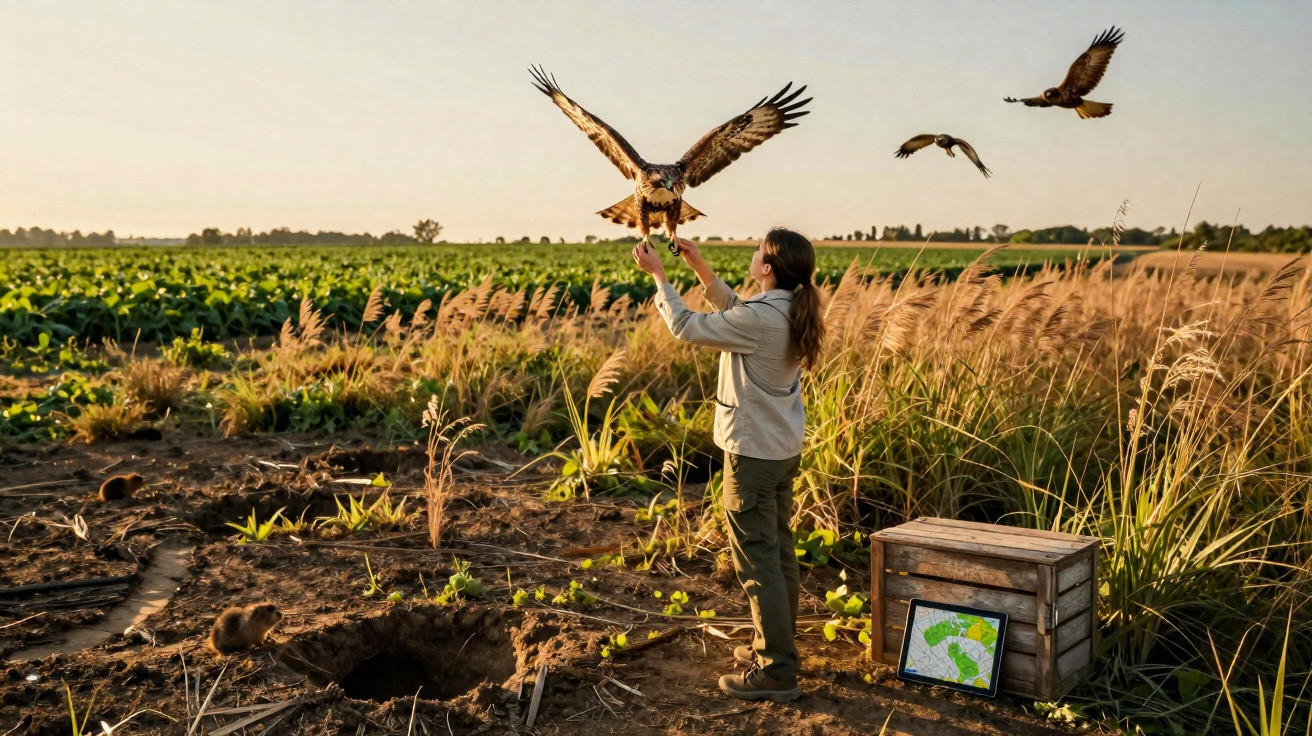
Raptors are back – and the ground is reacting
Ao fim da tarde, quando a luz baixa e o vento amansa, basta encostar-se a uma sebe para perceber que o céu já não está “vazio”. Uma ave de rapina paira, ajusta as asas, inclina a cabeça como se estivesse a ouvir o campo - e, algures lá em baixo, um roedor comete um erro.
Pouco depois, a mesma sombra desliza e desaparece com uma presa nas garras. Para quem trabalha a terra, o alívio é imediato: menos isco com veneno, menos armadilhas, um pouco mais de equilíbrio. Esta cena deixou de ser rara na Europa e na América do Norte. Repete-se milhares de vezes por dia, discretamente, por cima de paisagens normais.
Hoje, mais de 50 000 aves de rapina reintroduzidas patrulham céus que antes estavam silenciosos. Os roedores mudam de comportamento, as culturas sentem a diferença e as cadeias alimentares voltam a mexer - algo que, há vinte anos, soaria a otimismo demais.
A grande surpresa é a velocidade com que este efeito em cadeia se espalha.
Stand by a hedgerow at dusk in northern Spain or central England and you can feel it. The air above farmland no longer feels empty. Buzzards spiral on rising air, barn owls skim low over grass margins, kestrels hang in the wind like living kites.
These aren’t just pretty sightings for birders. They’re part of a quiet ecological experiment happening at landscape scale. More than 50,000 birds of prey have been reintroduced or actively supported in recent decades across Europe and North America, from red kites in the UK to Harris’s hawks in US cities.
As they return, rodents are no longer just cute, hidden neighbors. They’re back to being what they’ve always been in healthy systems: watched.
On a patchwork of farms in the UK’s Chiltern Hills, red kites were once down to a handful of pairs. Today, after reintroduction efforts started in the late 1980s, there are thousands. Locals talk about the sky “coming alive again”. Farmers talk differently. One grower describes a 30–40% drop in visible vole damage in certain fields since birds began nesting in nearby woods.
In Catalonia, Spain, agri-environment schemes added perches and nest boxes for barn owls over vineyards and cereal crops. Within a few breeding seasons, owl territories overlapped areas that had been heavy hot spots for rodent outbreaks. Grape losses from gnawing, once shrugged off as an unavoidable cost, noticeably eased.
Even urban spaces are in on it. In some US cities, red-tailed hawks and peregrine falcons use skyscrapers as cliffs, quietly policing rat populations near parks and rivers while office workers scroll through their phones below, mostly unaware of the aerial drama above their heads.
What’s actually happening here isn’t magic, it’s basic ecology finally being given room to work. Rodents breed fast and eat relentlessly when nobody is hunting them. Bring in predators, and the whole script shifts. Field studies show that it’s not only about how many rodents are killed. It’s about how rodents start to live in a state of fear.
Voles spend less time in the open. Mice forage in shorter bursts. They nibble fewer seedlings and young shoots because every second in exposed ground could be their last. Ecologists call this the “landscape of fear”, and it ripples outward. Plants recover. Ground cover thickens. Soil holds more moisture. That small silhouette in the sky ends up touching earth, water, and even carbon cycles.
These reintroduced birds are slotting back into trophic cascades that were partly broken by decades of persecution, pesticides, and habitat loss. You can almost watch the food web knitting itself together again, thread by thread, wingbeat by wingbeat.
How people are quietly working with raptors instead of fighting rodents
On a farm in Italy’s Po Valley, a simple wooden pole stands alone at the edge of a wheat field. At first glance, it looks pointless. No wires, no signs, just a pole. Then a common buzzard lands on top, swivels its head, and starts scanning the ground like a security camera.
That pole is a hunting perch, part of a growing toolbox for inviting birds of prey to do the work that poisons and traps used to do. The method is almost disarmingly simple: give raptors safe vantage points, nesting spots, and nearby wild strips where rodents feel bold enough to venture. Farmers in parts of Spain, Portugal, Israel, and California are installing perches every 100–200 meters along field margins.
Balanced right, each pole can become the center of a natural rodent control zone, powered by nothing more than hunger and gravity.
Plenty of land managers already know that poisoning rodents can backfire. Secondary poisoning climbs up the food chain into foxes, owls, and even pets. Yet, when the first signs of gnawed stems show up, panic is real. We all know that reflex to grab the fastest, strongest fix on the shelf and *deal with it*.
The shift toward raptor-friendly methods needs patience and a little faith. It also helps to start small. A single barn owl nest box over a problem field. A buffer strip of rough grass along one fence. A couple of wooden perches instead of a line of bait boxes. Soyons honnêtes : personne ne fait vraiment ça tous les jours, parfaitement, sur toute sa propriété.
What matters is starting to treat raptors as allies, not random background wildlife. When farmers talk to each other about what works, the change spreads far faster than any government leaflet.
Ecologist Ana Martínez, who works with wine growers in La Rioja, likes to frame it this way:
“You’re not ‘introducing predators’ to your land, you’re reopening a job position that’s been vacant for fifty years.”
Her team brings maps, simple data sheets, and a promise: if growers provide sky-high “infrastructure” for owls and kites, they’ll help monitor rodents, crop damage, and nesting success.
- Install 3–5 perches per 10 hectares of open field, away from busy roads.
- Add at least one barn owl box near rodent hot spots, facing away from prevailing rain.
- Leave some edges messy: tall grass, hedges, rough vegetation for prey and cover.
- Phase out the strongest rodenticides, especially near known raptor perches.
- Keep simple notes: sightings of raptors, rodent signs, and damage through the year.
On paper, it sounds like one more thing on an already full to-do list. On the ground, many farmers say it feels like finally having backup.
When skies fill, food webs remember
We tend to notice birds of prey when they’re gone, and then again when they return. The middle years – the silent ones – can feel normal at the time. On a personal level, that’s the hardest part to admit. On a landscape level, it’s exactly what’s changing right now.
As red kites whirl over motorways, as kestrels dot fence posts from Poland to Portugal, as hawks circle above suburban parks, something deeper is happening than just “more birds around”. Trophic cascades – those top-down ripples where predators shape prey, and prey shape plants – are quietly reawakening.
On a hillside of young trees in Wales, foresters noticed saplings finally making it past their most vulnerable years, with fewer being ring-barked by voles. In a Californian orchard, growers report that owl nest boxes have become as normal as irrigation valves. In small European valleys where rodent outbreaks once felt like natural disasters, there’s a new phrase making the rounds: “Let the raptors work.”
We’ve long told a story where humans manage nature from the top, clipboards in hand. This wave of over 50,000 reintroduced and encouraged raptors tells a different story. One where we tweak a few conditions, then step back, watch, and adapt as hawks, owls, and kites do the heavy lifting.
There’s still conflict. Chickens get taken. Pigeon racers complain. Some people simply don’t like the idea of sharp beaks and hooked claws overhead. And yet, every year, more regions are quietly joining the experiment. Not out of romance, but because poisoned bait is expensive, risky, and ultimately fragile. A kestrel, once settled, hunts for free.
On a cool evening, when a barn owl ghosts out of a nest box you helped hang, carrying a struggling mouse back to its chicks, the whole chain becomes visible. You, the wood, the bird, the rodent, the soil, the next harvest. It’s messy, it’s not fully under control, and that’s exactly why it works.
We’re not just saving raptors from extinction lists. We’re rediscovering what happens when sky and ground strike a kind of uneasy, functional truce. On a planet where climate and biodiversity headlines often feel crushing, that quiet, circling shape over a field is more than a pleasant sighting.
It’s a reminder that when you give ecosystems even a little room, they remember how to take it from there.
| Point clé | Détail | Intérêt pour le lecteur |
|---|---|---|
| Raptors regulate rodents | Over 50,000 reintroduced birds of prey are cutting rodent numbers and changing their behavior across farms and towns. | Shows how natural predators can reduce crop damage and reliance on poisons. |
| Simple tools work | Perches, nest boxes and rough field margins invite owls, kites and hawks to hunt effectively. | Gives concrete ideas any landowner or community can adapt, even on a small scale. |
| Trophic cascades are back | Predators shape prey, prey shape plants, and plants influence soil and water, restoring food web balance. | Helps understand the bigger picture behind a single bird in the sky – and why it matters to everyday life. |
FAQ :
- Are reintroduced birds of prey really taking a big bite out of rodent numbers?Not every study agrees on the exact percentage, but many show noticeable drops in visible rodent damage and activity around fields where raptors hunt regularly.
- Do more raptors mean fewer pesticides on farms?In several regions, yes. Farmers who trust barn owls, kites or buzzards often reduce their use of rodenticides, especially the strongest ones.
- Can this work in cities and suburbs too?To a degree. Hawks and owls in urban areas do hunt rats and mice, especially around parks, rivers and large yards, though waste management still matters a lot.
- Is there a risk for pets or small livestock?Small outdoor pets and unprotected poultry can be vulnerable in some situations, so basic protection like covered runs and night housing stays essential.
- How can an ordinary person help raptors come back?You can support nest box projects, protect old trees, avoid second-generation rodenticides, and back local conservation groups working with farmers and towns.





Comentários
Ainda não há comentários. Seja o primeiro!
Deixar um comentário