
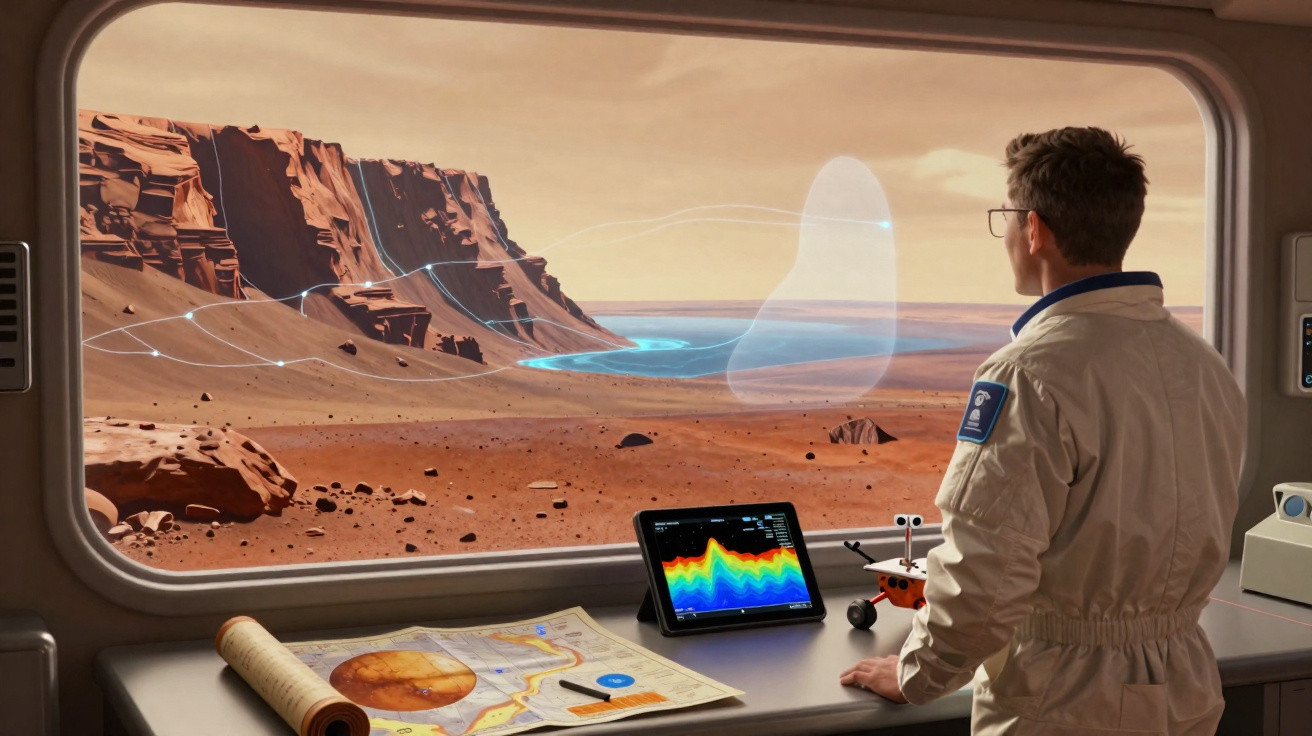
Hidden Martian coast
Durante anos, a discussão sobre um possível oceano em Marte girou em torno de “linhas” de costa difíceis de conciliar. Um novo estudo muda ligeiramente o foco: em vez de procurar um contorno perfeito, identifica uma faixa ampla, em forma de plataforma, onde esse oceano antigo poderá ter encontrado terra firme.
Essa abordagem reforça a ideia de que a água terá coberto cerca de um terço do planeta e ajuda a perceber por que os mapas de linhas costeiras feitos anteriormente nunca batiam certo entre si.
Across the northern lowlands, the terrain holds an unusually broad belt of flat ground far below Mars’ reference level.
Tracing that belt across the planet, Abdallah S. Zaki at the California Institute of Technology (Caltech), linked it to the kind of coastal margin oceans leave behind on Earth.
Rather than preserving one sharp edge, that ancient coast seems to have survived as a wide zone built and reshaped over long stretches of time.
That broader signature makes the ocean case more coherent, but it also raises the next question of why earlier researchers focused on shorelines in the first place.
Missing shoreline clues
Earlier maps chased shoreline traces that should have sat at one level, yet some wandered by miles from place to place.
Later volcanic loading, planetary tilting, impacts, and erosion could warp or erase any narrow edge left by ancient water.
A long-lived sea, however, can leave something broader: a coastal zone built and rebuilt by sediment, waves, and shifting water levels.
That wider target explains why one line proved elusive, and why a broader coastal zone could survive even after the ocean vanished.
Earth sets pattern
On Earth, a continental shelf, the broad submerged edge of a continent, marks the real transition from land to sea.
Rivers slow there and drop sediment, while waves plane the seabed and spread material across a broad, gentle platform.
Most shelf areas lie 15 to 410 meters below sea level, and that band minimizes curvature, a measure of terrain bending.
Those features gave the Mars search a concrete template, because deltas and shelves outlast fragile shoreline fragments.
The shelf candidate
Mars showed two broad, flatter zones, but only the higher one lined up with old river mouths, deltas, and proposed coastlines.
That favored band sits about 1.8 to 3.9 kilometers below the reference surface and hugs the divide between highlands and lowlands.
When the team tuned the map to Earth, the settings recovered 69–71% of Earth’s shelf.
Applied to Mars, the method outlined 10.1 million square kilometers of possible coastal shelf, about 7% of the planet.
How shelves form
On any world with open water, rivers feed the margin, building low plains that later spread seaward across shallow water.
Waves then shave high spots, while rising and falling seas stack fresh sediment across the same broad corridor.
Mars likely did this over millions of years, even without Earth’s moving plates, because deposition and erosion work there too.
The result would be a shelf that stores many shoreline moments at once, instead of preserving one perfect waterline.
Clues in rock
Topography was not the only clue, because the same band already held river deltas, coastal deposits, and thick layered rocks.
Near Utopia Planitia in Mars’ north, China’s Zhurong rover found 10 to 35 meters of sediment dipping seaward like coastal beds.
The proposed shelf also overlaps more than 14,000 layered mounds, some 500 meters thick and older than 3.7 billion years.
Those overlaps matter because flattening, like lava or flood deposits, would have a harder time explaining so many coastal clues at once.
A changing sea
Two large Martian delta systems record water-level swings of 500 to 900 meters, far larger than recent Earth examples.
Official coverage with the paper cast the shelf as the missing link between flat terrain, deltas, and shoreline traces.
“If there is an ocean, there must be a shelf,” said Zaki.
Repeated advances and retreats across one shelf would naturally scatter shoreline traces, while still preserving the broader shape of an ocean margin.
Where rovers look
Future rovers have a sharper target: the shelf could preserve coastal sediments where waves, currents, and river runoff once interacted.
Such rocks might contain clinoforms, sloping sediment layers built at a shoreline, along with ripple textures and storm beds.
“This is a more stable topographic signature,” said Zaki, explaining why a shelf may outlast a shoreline.
That matters because shelf deposits can record long environmental histories, making them stronger habitability targets than a single eroded shoreline.
Limits of proof
Caution matters, because Mars has endured billions of years of wind erosion, impacts, volcanism, and floods since the ocean era.
Local lava flows or flood sediments can flatten terrain too, so no single flat patch proves an ocean by itself.
Even so, matching shape, elevation, sedimentary clues, and rover evidence in one band raises the bar for simpler alternatives.
The remaining test is direct fieldwork, where future missions can examine whether these rocks truly formed beside open water.
What changes now
Mars has a stronger ocean case because the argument no longer depends on battered shorelines behaving perfectly after billions of years.
By treating a shelf as the real signature, researchers gain a clearer way to read ancient seas and choose future drilling sites.






Comentários
Ainda não há comentários. Seja o primeiro!
Deixar um comentário