
Movement begins underwater
A luz não serve apenas para iluminar - neste estudo, ela comporta-se como um “motor” sem combustível. Um feixe laser conseguiu levantar e orientar pequenos chips com padrões microscópicos em três dimensões, transformando a própria luz em tracção e sustentação.
O resultado empurra a propulsão movida a luz para lá de uma curiosidade de laboratório, sugerindo um futuro em que máquinas se deslocam sem contacto físico nem propulsores tradicionais, apenas com energia direccionada.
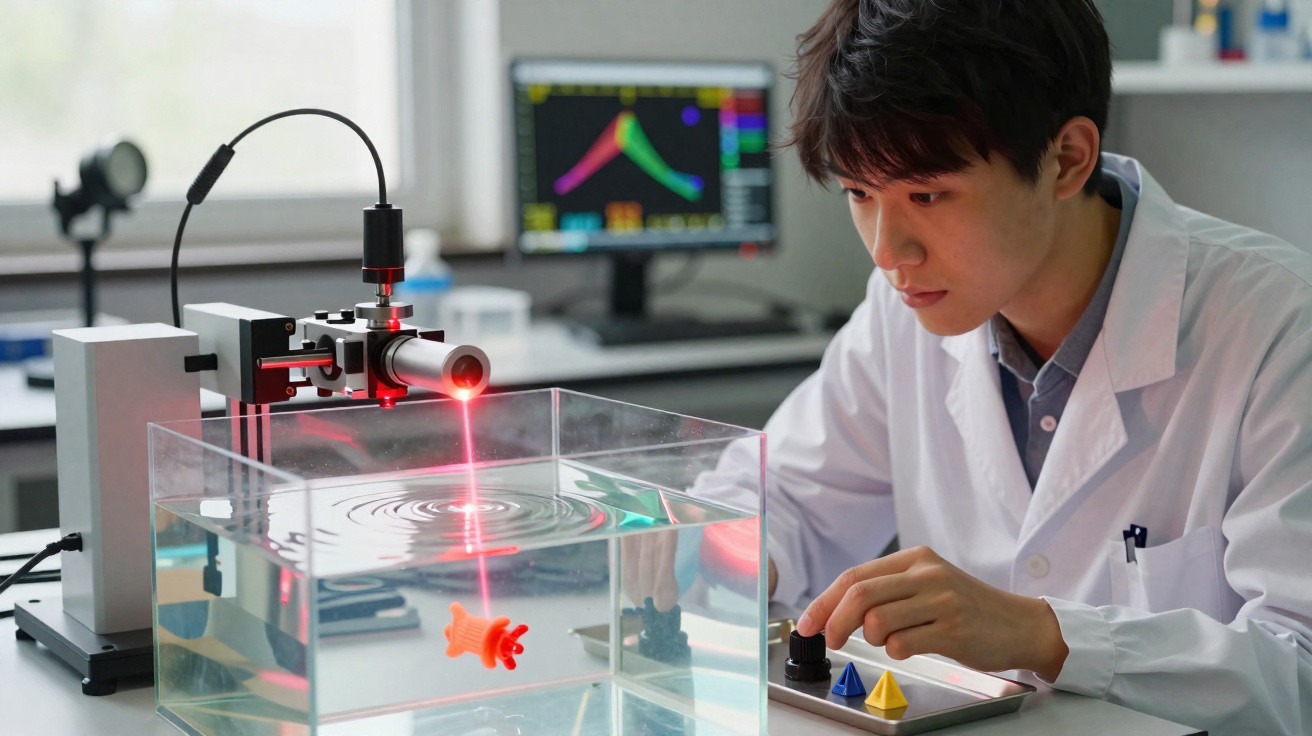
Inside a water-filled cell, researchers observed as free-floating metajets moved sideways and upward as laser light struck their patterned surfaces.
Working at Texas A&M University (TAMU), Dr. Shoufeng Lan and his team documented that motion as the devices redirected the beam and recoiled in response.
The same tiny structures did not merely drift along the light’s path, but moved against the bent beam while also rising through the fluid.
That controlled motion established the phenomenon clearly enough to shift focus to how the surface itself converts light into force.
Physics behind the push
When the patterned metasurface, an ultrathin light-shaping layer, bent the beam, changing photon momentum made the device recoil.
This followed the same action-and-reaction rule, except light supplied the shove instead of exhaust.
Lan’s group termed that engineered reaction a metaphotonic force – able to point sideways, upward, or in a mix of both.
With the force model in hand, the experiments became straightforward to interpret, because the motion tracked where the redirected light travelled after leaving the surface.
Fabrication sets direction
Each device used silicon nanopillars, tiny columns of silicon, arranged so neighbouring elements delayed the wave by different amounts.
By changing pillar size, the team adjusted that timing, which fixed the beam’s exit angle and, with it, the force direction.
One early version directed 58% of incoming light into the target path, enough to measure motion clearly.
This fabrication control didn’t eliminate headaches for the scientists, but it did indicate the geometry was doing the work rather than stray heating.
A clear pattern emerges
Five repeated runs under identical laser conditions produced the same signature – steady travel in one direction, minimal sideways drift, and a rise upward.
When the laser switched on, the device accelerated upward and then stabilised at the chamber’s ceiling.
Video frames captured every five seconds showed the object moving opposite to the bent light, exactly as predicted.
Those measurements mattered because they anchored the theory to a visible, verified trajectory, not just a calculation on a screen.
Shifting complexity to the object
Earlier optical micromachines often relied on shaped or steered beams, as a 2020 nanomotor study made clear.
Here, the beam remained simple while the patterned object took on much of the steering.
Pushing control into the object removed a key bottleneck, since redesigning a device can be easier than rebuilding laser hardware around a moving target.
The approach also looked more like a platform than a one-off trick tied to a single setup.
Tradeoffs shape motion
Using fewer pillars in each repeating pattern pushed light further sideways, boosting horizontal thrust but cutting lift.
Adding more pillars did the opposite, reducing the sideways shove while strengthening the vertical force.
Because both motions came from the same light, tuning one direction altered the other. That tradeoff turned propulsion design into a balancing act, not a simple race for speed or maximum lift.
Scaling the idea upward
The striking point wasn’t the device’s tiny size, but the rule behind it: more light meant more force, even at scales smaller than a human hair.
“The optical force scales with incident power and is not fundamentally dependent on the size of the metajet,” the researchers wrote.
That logic quickly shifts attention to Alpha Centauri, the nearest star system to the Sun.
Directed-energy proposals have already outlined roughly 20-year trips for laser sails weighing a fraction of an ounce, even though this test stayed far smaller.
Barriers to real-world use
Gravity still complicated the experiment, so the team used liquid to soften its effect, partly offset weight, and make the motion easier to see.
Outside that setup, real systems must deal with beam stability, heating, alignment, and materials that can survive intense light over long distances.
None of those hurdles cancels the data, but tests remain more difficulty regarding future spacecraft, especially without lab supports.
Microgravity tests, higher powers, and tougher materials will matter most in the next phase.
From micromachines to spacecraft
One reason the result stood out was its range: the same physics could feed into several future projects.
At small scales, contact-free motion could shift delicate parts inside future miniaturised machines without tethers, gears, or onboard propellant.
Farther out, laser propulsion may draw interest because a remote power source can keep pushing after rockets run dry and fuel is gone.
This data helps explain why a device drifting through water may matter for future space exploration.
By turning one beam into coordinated sideways thrust and upward lift, this work made abstract momentum both visible and practical.
The next advances will depend on stronger materials, steadier lasers, and test conditions that better match space and survive longer illumination.






Comentários
Ainda não há comentários. Seja o primeiro!
Deixar um comentário