
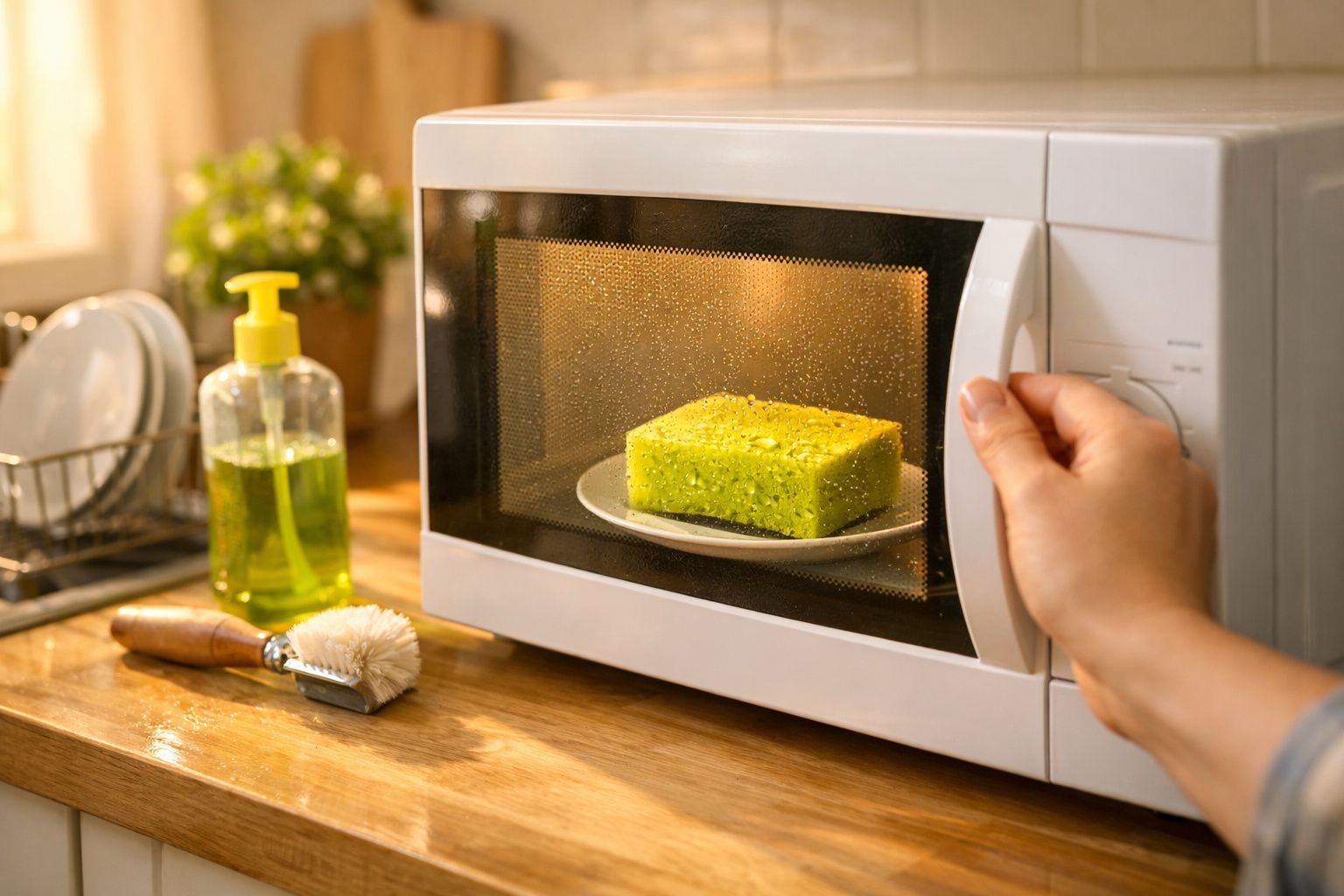
The sponge was already suspicious before I even touched it.
It sat there by the sink, greyish, with that stale, damp smell that says it hasn’t properly dried in days. When I picked it up, it felt slimy between my fingers and I had the same thought many of us have in the kitchen: do I bin it now, or carry on pretending it’s still usable?
A friend who was watching me from the kitchen table just pointed at it and said, “Why don’t you microwave it?”
I laughed. It sounded like one of those internet tricks that goes wrong on purpose. Who puts a filthy sponge in the same appliance they use to heat soup?
Then she explained it in two sentences that genuinely changed the way I clean my kitchen.
Since that day, every time I open the microwave door, I think about one small, soaked rectangle that says a lot about the dirt we don’t see.
And about the things we choose to ignore.
That gross sponge on your sink is dirtier than your toilet
If you’re reading this, chances are you’ve got one of those “loyal” sponges too.
The one that’s been hanging around for weeks, a bit frayed at the edges, stained with tomato sauce, coffee and some mystery colour you no longer ask about.
We wipe the table with it, then the counter, then maybe a plate “just for a second”.
We rinse it under lukewarm water, squeeze it twice, and call it clean.
The problem is that the sponge slowly turns into a sort of bacteria Airbnb.
Warm, damp, packed with food residue.
Basically the ideal address for germs.
A study from the University of Furtwangen in Germany looked at used kitchen sponges from ordinary homes.
They found tens of billions of bacteria in a single sponge, including some of the same types you find in toilets.
One of the sponges in the study had seven times more bacteria than a dirty kitchen sink.
Not because people were filthy, but because they did what most of us do: rinse, squeeze, reuse.
We’ve all had that moment when you realise the thing you use to clean your dishes may actually be spreading more grime than it removes.
The numbers sound dramatic, but they just confirm a day-to-day reality we’d rather not stare at too closely.
Here’s the logic behind the horror story.
Bacteria love moisture, warmth and tiny bits of food. A sponge gives them all three.
Once they settle in, they multiply quickly.
Every time you wipe a chopping board or a mug, you’re dragging that invisible colony across the kitchen.
You might not get ill every time, of course.
Our immune systems are strong and daily life already exposes us to bacteria anyway.
But when raw meat juices, warm temperatures and a tired sponge come together, the risk quietly rises.
That’s why the microwave trick suddenly feels less like a hack and more like common sense.
How microwaving a damp sponge actually helps
Here’s the basic method my friend showed me.
You take the sponge, rinse it well under the tap, and soak it with clean water.
Then, and this is the important bit, you put that dripping sponge on a clean plate and place it in the microwave.
Close the door and set it for about one to two minutes on high power.
Inside, the water in the sponge heats up and starts to boil.
The steam gets into the tiny holes where bacteria hide, and many of them don’t survive the heat.
When the microwave beeps, don’t grab it straight away.
Let it sit for a moment, because that sponge will be scorching hot.
Once it cools down a little, you’ve basically given it a mini pasteurisation session.
People usually make two mistakes with this trick.
First, they microwave a dry sponge, which is much less effective and can even be a fire hazard.
Second, they assume one “microwave clean” means the sponge lasts forever.
It doesn’t. A worn sponge still needs replacing regularly, even if you’ve reduced the germs.
Let’s be honest: nobody does this every single day.
Life is messy and evenings are short.
Doing it a few times a week, or after handling raw meat or cleaning something especially nasty, is already a big improvement.
It’s less about perfection and more about not wiping your chopping board with a bacteria party.
“Microwaving a damp sponge won’t magically turn it into a sterile lab tool,” a food safety specialist once told me, “but it can significantly cut down the microbial load and reduce cross-contamination in everyday kitchens.”
Always soak the sponge first
It should be wet, almost dripping. The water is what heats up and does the real work.Use short bursts of time
Start with one minute on high. If your microwave is weaker, increase in 20–30 second steps.Avoid metal or scrub pads with wires
Anything metallic in the microwave is a bad idea. Stick with ordinary soft sponges.Let the sponge cool before touching it
Pick it up with tongs or wait a bit. That trapped steam is no joke on bare fingers.Pair this trick with regular replacement
Microwaving helps with germs, not with holes or smells that won’t shift.
What this tiny ritual quietly changes at home
Once you start microwaving a damp sponge, something subtle shifts in the kitchen.
You become a bit more aware of the invisible layer of life on every surface.
Not paranoid, just more awake.
You think twice before wiping raw chicken juices and then using the same sponge on your child’s cup.
You might even feel a small flash of satisfaction every time the microwave pings, knowing you’ve just knocked down the bacteria count in the room.
It’s almost like resetting a tiny part of the day.
And this slightly odd habit often leads to other small routines.
Washing dishcloths more often. Letting the sink actually dry. Keeping one sponge for dishes and another for everything else.
The microwave doesn’t fix everything, of course.
Still, this one simple habit can make a real difference to how clean “clean” really is at home.
| Key point | Detail | Value for the reader |
|---|---|---|
| Microwave only a damp sponge | Soak it with clean water, then heat for 1–2 minutes on high | Reduces germs more effectively and avoids fire risk |
| Use the trick regularly, not obsessively | Focus on high-risk moments: after raw meat, sticky messes, or bad smells | Better hygiene without stress or unrealistic routines |
| Combine microwaving with replacement | Change sponges every 1–3 weeks, depending on use and smell | Keeps both bacteria levels and overall kitchen hygiene under control |
FAQ:
- Question 1Does microwaving a sponge really kill bacteria, or is it just a myth?
- Answer 1Heating a very wet sponge in the microwave can significantly reduce the number of bacteria, especially those sensitive to high temperatures. It doesn’t sterilise it completely, but it does lower the microbial load compared with a sponge that’s only been rinsed under the tap.
- Question 2How often should I microwave my kitchen sponge?
- Answer 2If you cook every day, doing it a few times a week is already a good rhythm. Focus on days when you’ve handled raw meat or cleaned up something particularly dirty. You don’t need to stress about doing it every single day for the habit to be useful.
- Question 3Can I microwave any type of sponge or scrubber?
- Answer 3Stick to standard non-metallic sponges. Avoid anything with steel wool, metal fibres, or odd inserts. Some very thin or cheap sponges can warp, so start with shorter heating times and see how they react.
- Question 4My sponge still smells bad after microwaving. What does that mean?
- Answer 4A stubborn bad smell usually means the sponge has reached the end of its life. Microwaving helps with germs, not with deep-set odours and worn-out material. At that point, the best option is to throw it away and start fresh.
- Question 5Isn’t it gross to put a dirty sponge inside the microwave where I heat food?
- Answer 5A lot of people feel uneasy about that, which is understandable. You can place the sponge on a microwave-safe plate and wipe the inside of the microwave afterwards with a clean cloth. The heat mainly acts on the sponge itself, and a quick clean of the microwave keeps everything feeling hygienic.





Comentários
Ainda não há comentários. Seja o primeiro!
Deixar um comentário